

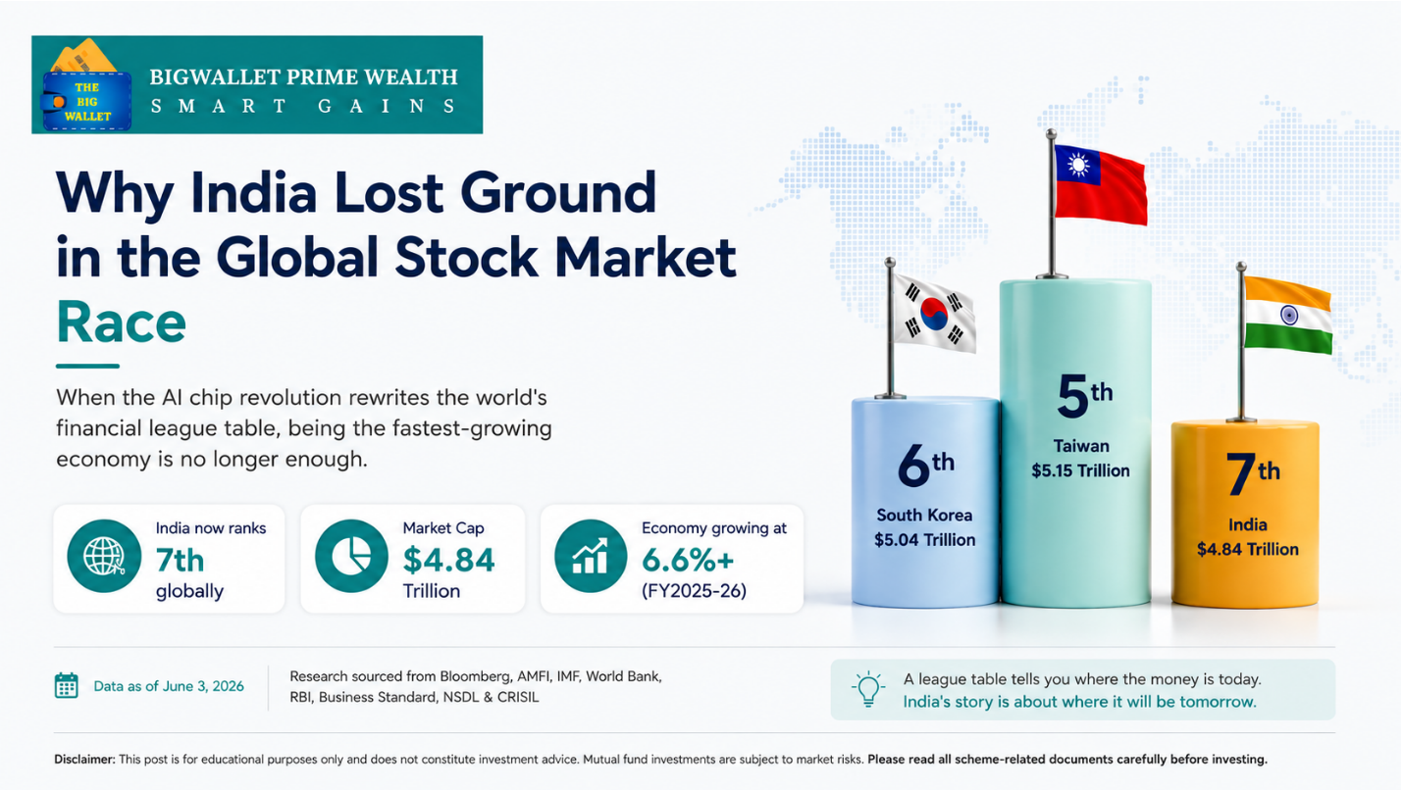

When the AI chip revolution rewrites the world’s financial league table, being the fastest-growing economy is no longer enough.
Research sourced from Bloomberg, AMFI, IMF, World Bank, RBI, Business Standard, NSDL & CRISIL | June 3, 2026
The League Table Has Changed
Picture a cricket scoreboard — except instead of runs, it tracks how much every country’s publicly listed companies are worth. That scoreboard shifted dramatically in the last week of May and first days of June 2026. In just seven days, India slipped two places — from a brief 5th position in early 2024 to 7th today.
First Taiwan pushed past India. Then, on June 2, 2026, South Korea followed. India now sits at 7th globally with a market cap of $4.84 trillion, while Taiwan stands at $5.15 trillion and South Korea at $5.04 trillion, per Bloomberg data.
For a country that once celebrated cracking the world’s top-five club, this moment deserves clarity — not panic.
What Is Market Capitalisation? And How Is It Different from GDP?
Market capitalisation is the total value of all publicly listed companies in a country. Take every listed company’s share price, multiply by shares outstanding, add it all up. Do that for every company on the BSE and NSE, convert to US dollars, and you have India’s stock market cap.
This is not the same as GDP. Gross Domestic Product measures actual economic output — goods made, services rendered, crops harvested. Market cap measures what investors believe those listed companies are worth today.
The gap between the two is at the heart of this story. India’s $4.15 trillion economy — the world’s fourth-largest by GDP per IMF data — is significantly bigger than South Korea’s $1.93 trillion GDP. India produces more. India earns more. But South Korea’s stock market is worth more right now, because of what its listed companies make and who is buying them.
How India Rose — and Why the World Moved Faster
India’s climb up global rankings has been remarkable. In 2015, India was 10th globally with a market cap of $1.33 trillion. By 2021, it recovered to 8th at $2.5 trillion. Then came an extraordinary bull run — powered by post-pandemic consumption, a surge in retail investing, and foreign capital flowing in as India positioned itself as the world’s most attractive emerging market.
By September 2024, India’s market cap touched an all-time high of $5.7 trillion, briefly placing it 4th globally. The story felt unstoppable.
Then the world changed its mind about what it wanted to own.
The AI and Semiconductor Advantage: Why Taiwan and South Korea Won This Round
Artificial intelligence runs on chips. And chips, in 2025-26, ran on Taiwan and South Korea.
TSMC — Taiwan Semiconductor Manufacturing Company — manufactures the most advanced chips on the planet. Every Nvidia GPU powering an AI data centre was made by TSMC. As the global AI buildout accelerated, TSMC’s earnings surged, its share price soared, and because TSMC dominates Taiwan’s market cap, the entire country’s ranking rose with it. Taiwan’s Taiex index climbed more than 50% in 2026 alone.
South Korea’s story is Samsung Electronics and SK Hynix. Both are now members of the $1 trillion valuation club, per Bloomberg data. SK Hynix makes High Bandwidth Memory (HBM) chips — the specific memory architecture that AI processors like Nvidia’s H100 require to function at scale. As AI data centre demand exploded globally, HBM demand exploded with it. South Korea’s total market cap soared 86% in 2026, with the KOSPI gaining over 100% year-to-date by early June.
Semiconductors and high-bandwidth memory account for nearly 60% of market cap in both Taiwan and South Korea, cementing them at the centre of the global AI value chain.
India had no answer to this. As Abhay Laijawala of Lighthouse Canton said bluntly: “Within the EM universe, semiconductors are the domain of Taiwan and Korea. India has none. Therefore, India has no meaningful role in the most transformative cycle since the internet boom.”
India’s Challenges in 2025-26
Foreign investors left at record pace. Total net FPI outflows reached just under Rs 2.3 lakh crore between January and May 2026 — already surpassing the Rs 1.66 lakh crore that left in all of 2025, per depository data. Global funds sold nearly $24 billion of Indian equities this year, chasing the AI boom in Taiwan and Korea. The rupee’s slide from 85 to roughly 95 against the dollar compounded losses for dollar-denominated investors.
Valuations were stretched, earnings disappointed. After India’s 2023-24 bull run, Indian equities traded at 21 times estimated forward earnings — well above the 20-year average of 17.5x, per Business Standard. Korea, Taiwan, and Japan were priced near recession-trough valuations. Then India’s corporate earnings underwhelmed in FY25, with weak results and global headwinds from US tariffs.
No semiconductor companies on the board. India’s IT sector is services-led — writing software, managing IT infrastructure, building digital products. It is not making the silicon that AI runs on. That distinction, which seemed minor for years, turned out to be everything in 2025-26.
Why This Ranking Does Not Tell the Complete Story
Domestic investors have become India’s backbone
Even as foreign investors were exiting, Indian retail and institutional investors absorbed nearly 90% of FII selling. Monthly SIP contributions crossed Rs 31,000 crore for the first time in December 2025 — an all-time high, per AMFI data. Total SIP inflows for 2025 hit Rs 3.34 lakh crore, up from Rs 2.68 lakh crore in 2024. The mutual fund industry’s AUM grew 21% to over Rs 80 lakh crore. Demat accounts stood at 207 million by H1 FY2026, per CRISIL data. FII ownership has fallen to approximately 16% — the lowest in two decades — while domestic institutional ownership has, for the first time, overtaken it.
India’s economy is still the world’s fastest-growing
The IMF projects GDP growth of 6.6% for FY2025-26, while the RBI revised its own forecast upward to 7.3%. The World Bank projects 6.5%. India’s GDP per capita reached $2,810 in 2026. Analysts note the domestic consumption boom typically accelerates when per capita crosses $4,000. India is approaching that threshold.
Semiconductor ambitions are real, just early
On April 9, 2026, the government notified a Special Economic Zone for Tata Semiconductor in Dholera, Gujarat — India’s first chip fabrication facility. On May 16, 2026, Tata Electronics and ASML signed an agreement for a 300-mm wafer fab targeting 28-nanometre chips. India already supplies roughly 20% of the world’s semiconductor design engineers. The design capability exists. The fabrication capability is being built — with a realistic production timeline around 2028.
What Investors Should Learn
A ranking drop is not a market collapse. India’s market cap has grown enormously over the past decade. What changed is that Taiwan and South Korea grew faster in 2026 for one specific reason tied to one technology cycle.
Cycles turn. The AI chip boom has been the most concentrated re-rating in years. The most concentrated rallies also carry the highest correction risk. India, sitting out this rally, enters the next cycle with less froth and more room to run.
Keep your SIPs going. Investors who continued monthly SIPs through 2025-26 accumulated units at lower prices. When foreign capital returns — and historically it always does — those investors will have the most to gain.
Diversify globally. India-only portfolios missed the biggest equity story of 2025-26 entirely. Some allocation to global themes, including AI and semiconductor supply chains, is a sensible hedge.
The structural story is intact. A young, growing population. Rising incomes approaching the consumption inflection point. A maturing domestic investor base. A world-class digital economy. None of these trends have reversed.
Temporary or Structural? Honest Answer: Both
India’s lack of large listed semiconductor companies is a structural gap that will take a decade to close. It will not unseat TSMC in five years. That part is structural.
But the ranking itself is not permanent. If India’s corporate earnings rebound in FY2027, if foreign investors return as valuations normalise, and if the rupee stabilises, India could re-enter the top five quickly. It was 5th just months ago.
The deeper question — whether India builds the technology-manufacturing ecosystem to compete in the cycle after AI chips — is the one that matters most for the next decade. The seeds are being planted. Whether they grow into a forest depends on execution.
Conclusion
India slipping to 7th is a headline worth reading, not one worth panicking about. A global AI and semiconductor supercycle rewarded Taiwan and South Korea in ways India — without large listed chip companies — simply could not match in 2026.
But India’s economy is the world’s fourth-largest, growing faster than almost any other major nation. Its domestic investors are more disciplined and more numerous than ever. Its semiconductor story is beginning, not ending.
A league table tells you where the money is today. India’s story is about where it will be tomorrow.
This article is authored by Shubham Shah, at BigWallet Prime Wealth.
Disclaimer: This article is for educational purposes only and does not constitute investment advice. Mutual fund investments are subject to market risks. Please read all scheme-related documents carefully before investing.