
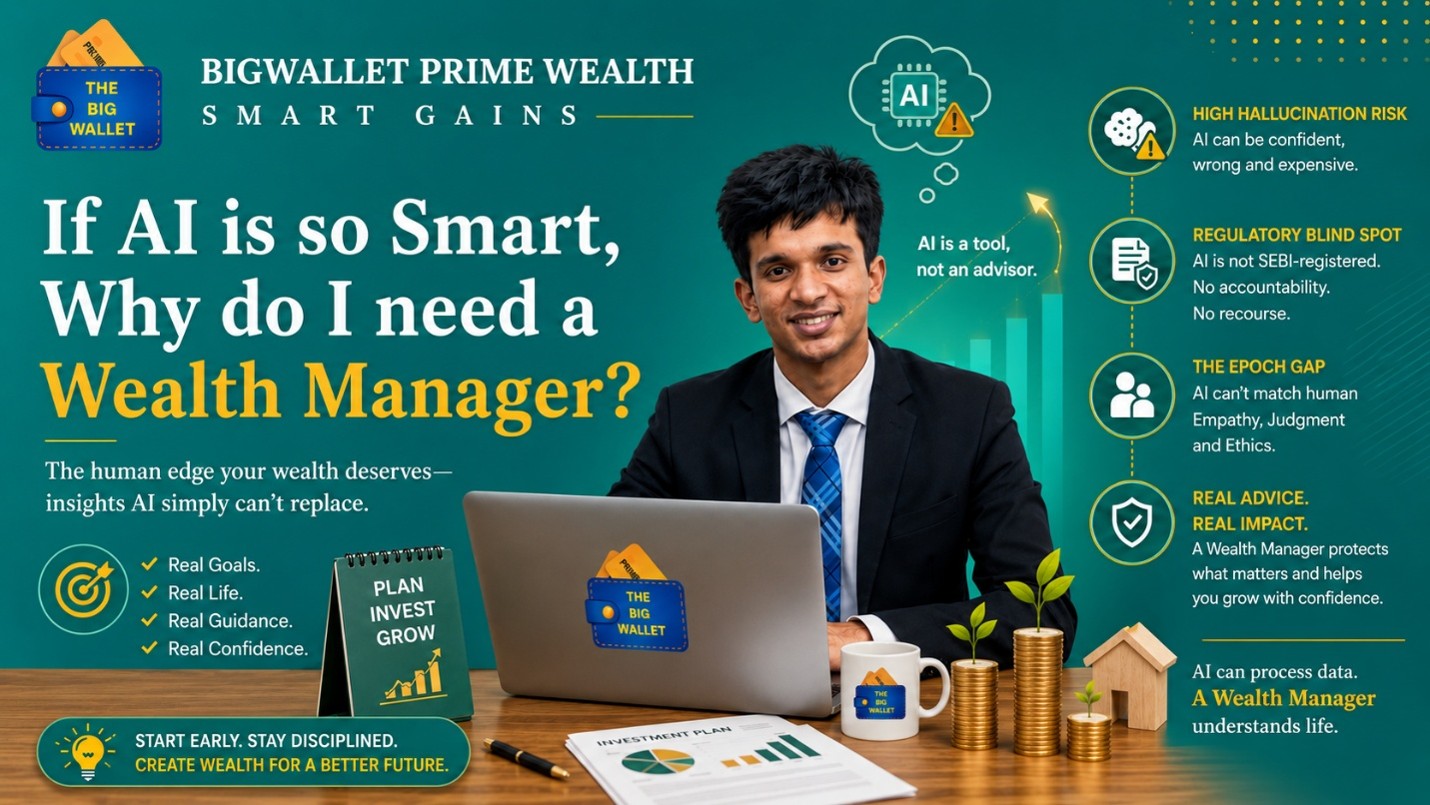

You hear it every now and then, self-acclaimed finance aficionados bestowing their uncontested words of investing wisdom upon the common folk over a cup of hot cutting chaai at the local tapri. It’s the same monotonous advice over and over again; start investing early, diversify your portfolio or the contemporary classic strategy – ‘Invest in SIPs’. A preliminary investigation of the source of their information would reveal the not-so-well-kept secret – it’s the latest AI platform in town. It started with ChatGPT, then the likes of Gemini, Deepseek and Perplexity joined in. Now, we have Claude AI taking over the headlines. This does beg the question – If AI is so smart, why do I need a Wealth Manager.
Let’s give credit where credit’s due. Claude has revolutionised the AI space. The advanced AI assistant launched by Anthropic is widely acclaimed for its high-performance text analysis, complex reasoning and on-demand coding capabilities. Its large context window allows it to handle hundreds of pages of text including PDFs, word documents and spreadsheets. Clerical and repetitive tasks such as documentation and content generation can be automated in seconds with a single prompt.
However, this is where the chaai gets cold. Ask any Claude to manage your actual wealth – accounting for your mother’s anniversary gift fund, your daughter’s overseas education expenses in 2031, the loan you co-signed with your brother, and tax-saving instruments your advisor recommended you last March – and you will quickly discover the seams in the fabric.
The Hallucination Problem: Confident, Wrong, and Expensive
The most dangerous quality of AI is not that it doesn’t know things. It’s the fact that it sounds like it does. Researchers have a clinical name for this: hallucination. A 2024 study found that large language models hallucinate in up to 41% of finance-related queries – which is nearly one in every two financial questions. The study also noted the tendency of models to deliver an answer even when the given context was insufficient. These features of AI agents reveal the critical financial and legal pitfalls of outsourcing your decision-making to automated systems.
The Regulatory Blind Spot
In India you cannot sell, market or distribute Mutual Funds to the public without a valid AMFI registration number. Following the same logic, AI platforms are not licensed financial advisors. In India, anyone providing investment advice must be a SEBI-registered Investment Adviser (IA) or Research Analyst (RA). SEBI’s December 2024 amendments made it explicit: the responsibility for investment advisory services lies solely with the IA or RA, irrespective of the scale and scenario of AI tool usage. Furthermore, IAs must disclose to clients the extent to which AI tools are used in providing investment advice. In plain terms – an AI is a tool, not an advisor. If Claude gives you bad advice and you lose money, there is no grievance redressal. No SEBI escalation. No recourse.
What AI Genuinely Cannot Do: The EPOCH Gap
Researchers at MIT and Oxford have been researching the irreducible human capabilities that financial advisory demands. One recent framework, published in a 2025 academic paper on the limits of AI in financial services, calls this the EPOCH framework:
Empathy and Emotional Intelligence;
Presence, Networking and Connectedness;
Opinion, Judgment and Ethics;
Creativity and Imagination;
and Hope, Vision and Leadership.
Many critical aspects of financial services are deeply reliant on these capabilities, highlighting the irreplaceable role of human expertise in areas where AI falls short. Your wealth is not just a number. It’s the product of 20 years of risk-taking, family sacrifices, career pivots, and aspirations that cannot be distilled down to a single prompt. Even ChatGPT, when asked whether AI can think like humans, responded that it lacks the lived experience, embodiment, and contextual grounding that shape human thought. The machine knows it, so should you.
Disclaimer:
This article is authored by Jinay Vora, at BigWallet Prime Wealth.The views expressed are for educational purposes only and do not constitute personalised investment advice.
Sources: